Ronny Hudson

From interview with Geoff P.
GP: No, I mean you can’t see a croc. No, they seem to be losing their fear. It’s that long ago since, you see Port back in the ’50s and ’60s, there was very intense croc shooting. Four or five blokes moved out of Port. Charlie Taylor, old Ronny Hudson, the bloke that I found dead up in his camp at Stoney’s

SC: And who was the bloke, the bloke who you saw who died?

GP: Ronny Hudson. I found him dead up in his camp up Stony Point. But yeah, they did some maximum croc shooting round the area and before them there were quite a lot of blokes, transients….it was big money back in those days. So the crocs thinned out and the ones that were there kept a very low profile, but that was what ’75 or ’74 or whatever it was. It was made illegal. So over the years…when we first went there the wharf was still there. It wasn’t until the navy blew it, but there was one big croc….I think he might still be there because I’ve seen him when I’m up on the hill. He does a transit. He’s a pretty big lizard, maybe four metres plus. He obviously goes back to the days of the war. If you watch him….say he’s coming north, he’ll come through the channel between Rocky and he’d come up to within 100m, he’d be on the edge of the reef and he’d go. He’d disappear for 10 minutes or so and then pop up…..even the wharf on the pier is all long gone he just decides…..he must associate that area with guns or humans or bad experiences.
Slack Dick

Alan Lucas talks about people getting blind drunk on that or being on the jetty or something and then being stacked horizontally onto a trailer behind a tractor and then driven out and then rolled off the trailer at their house. And Resto Dave reckoned it was Slack Dick, whose unfortunate nickname…
BV: Richard Carmody.
SC: Yeah, who could quote Shakespeare or great buckets loads of Shakespeare?
BV: No, he was an educated guy. So….
JP: Richard (Slackdick) Carmody’s father was secretary to Prime Minister Curtin.
SC: Okay.
BV: He was skilled in engineering. He was sent to public school in London. He was educated, he was well read.

Slack Dick
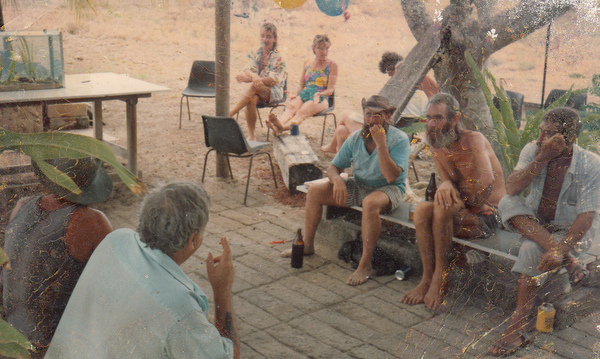
Slack Dick (centre on the bench) courtesy John Pritchard

BV: Once during a drug raid the cops had Slack bailed up in his shack and as others searched two of them sat and chatted to Slack. When they thought they had him in an unguarded moment they slipped in the question “Slack old mate how do you get your dope to cairns” Slack immediately told them his MO ” I fax down the dope and they fax back the money”

“And he famously, on his deathbed, he ended up with liver cancer – he was only in his fifties. My sister Mary was friendly with him. She used to go down and visit him in hospital when he was dying. But the end’s near and everyone’s packed around his bed, he props himself up on one elbow and he looks at them, he says. Well he said…and he was talking with his loud voice; ‘if I’d have known that I was going to live this long I’d have looked after myself a bit better’.”

“JP: Mitch was his mate, they were good mates. He knew that if he left any beer, Slack was going to drink it when Mitch went away….so in order to ensure that there was something to drink when he got home he would stash some beer in the fridge, in the crisper, under something. He knew that Slack would never look in the crisper under any circumstances for anything.”

Barbara Holdsworth

Sandie H: “She was our mother, if you signed her visitors book, you became one of her children.”

Barbara Holdsworth photo credit - Aust Geographic Magazine
Barbara Holdsworth photo credit – Aust Geographic Magazine


Barbara’s collection of plaster casts of purported to be footprints of big cats includes one that greatly resembles the Thylacoleo, a marsupial Lion reportedly extinct 20,000 years ago, Barbara was known as an eccentric and believed many undocumented species lived around Portland Roads.

My (Seamus) brother-in-law (Col) worked on the boats up this way many years ago and fondly remembers going to Barbara with an extremely painful migraine one day. She prescribed a tin foil pyramid hat – Col at that stage was willing to try anything – but now cannot remember whether the hat worked or not.

We met some yachties (world travellers who were in Portland Roads 30 years ago), who also had fond memories of Barbara and her cats. They remember she “had at least 50 cats – they were every where, on the seats, and every rafter had 3 or 4 cats”.
“She’d say ‘sit down’ and you’d say ‘where?’ There were cats on all the seats you know”

These yachties gave us some star sand that Barbara had given them.

Barbara Holdsworth photo credit Aust Geographic Magazine


[We have many photos of her writings and plaster casts as well as people to get more information about her from]

Richard Leo Bradbury “Kirky” Kirk

“Fellow eccentric Richard Leo Bradbury “Kirky” Kirk (above) glances past his latest painting ……………”  – credit: Australian Geographic October – December 1999, PP 108 – 109

Kirky - photo credit Aust Geographic Magazine
Kirky – photo credit Aust Geographic Magazine

Geoff P: “No, old Dick Kirk….Kirk and Lizzy used to live out there and herb hill out on the way to Jimbo’s old place. He was from Cedar Bay old Dick. Richard Leo Bradbury Kirk. He got his name from his mother … he was a really bad epileptic old Dick.
Everyone who had a house in Portland Road District had had Kirk chucking a wobbly and I mean he even used to have grand mals – they’d go for four hours. Yeah, that was old Dirty Dick.
He was actually a likeable bloke, but he was dreadfully obnoxious when he got on the booze and he wouldn’t take his epileptic medicine. So he’d have these grand mal fits. But yeah, a few times Billy Mitchell used to have a tray back and load Kirky and Lizzie and various other odds and sods onto the back because they would always deliver up there…..Jimbo’s, the ringers. Yeah, I don’t know if they had a tractor or a trailer. That could have happened earlier.
”

Brian V and John P: “Young Kirky. Kirky was in the first world war.  He was a bit of an artist. He was an accomplished artist, but he always had a morbid streak if you looked at any of his work. All his faces. People know him for painting fridges, there was many a fridge he painted.
Yeah, he painted fridge doors.“

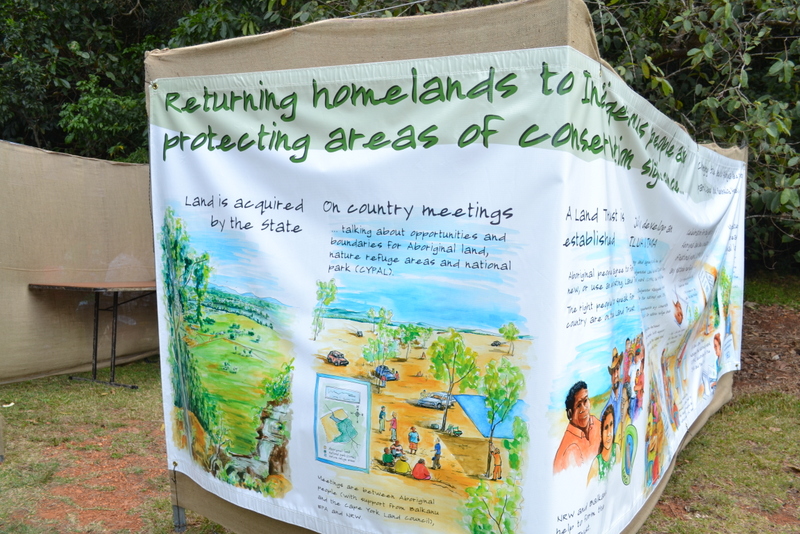
Poster at Kuuku yau handover

Kuuku Ya’u handover

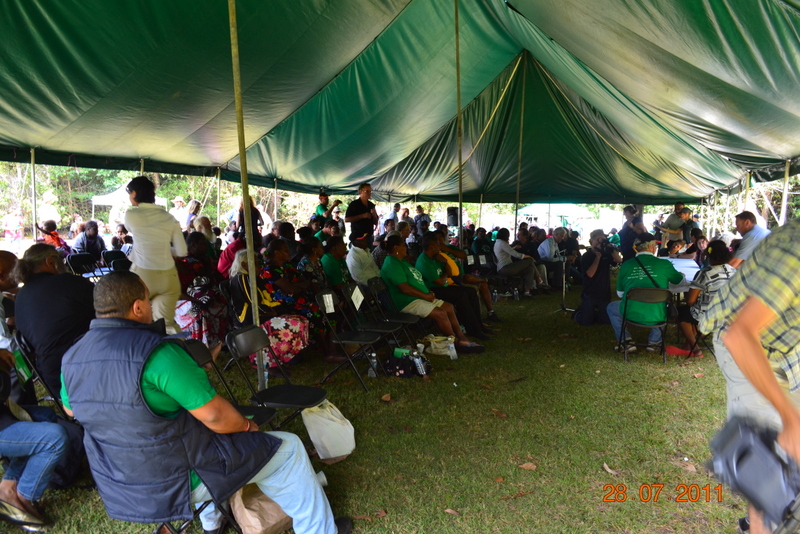
July 28th 2011 was the culmination of many years of struggle by the Kuuku Ya’a people to reclaim their traditional lands.

handover
handover

They met with government officials for the “signing of the indigenous management land use agreement for Kutini-Payarnu(Iron Range), Piper Islands, Wuthara Island, Mitirinchi Island and Ma’alpiko Island national parks (CYPAL)”, and the “delivery of deeds of grant to the Northern Kuuku Ya’u Kanthanampu Aboriginal Corporation RNTBC Land Trust”.

Poster at Kuuku yau handover

There were speeches from many people including David Thompson, the priest, linguist and anthropologist who gave thanks to the creator and acknowledged “the Traditional Owners, the Kuuku Ya’u People, including both Kungkay and Kanthanampu groups, Honorable Ministers Vicki Darling and Rachel Nolan, the Member for Cook, Jason O’Brien, mayor and councillors of Cook Shire Council and Lockhart River Aboriginal Shire Council, and other distinguished guests”.
He spoke movingly about the history and ended with: “The challenge today is to find a right balance between the past, the present and the future. Today’s handover is an opportunity for today’s generation to strengthen their ties with their land, their families and their ancestors, while at the same time looking to the future to make the best choices for life in the modern world.”

Jasmine and Greta
Jasmine and Greta

The elders were eloquent with their words and the depth of feeling was indicated when two of the younger traditional owners (Jasmine and Greta Accoom) impressed the audience with their moving and emotional words.

Environment Minister, Vicky Darling stated: “Iron Range National Park will expand by more than 7,700 hectares when the Bligh Government today transfers five national parks and adjacent areas on the Cape York Peninsula to the Traditional Aboriginal Owners.” She added that the Iron Range National Park will be “renamed the Kutini–Payamu (Iron Range) National Park – Kutini means cassowary and Payamu means rainbow serpent in the language of the Kuuku Ya’u people, the Aboriginal Traditional Owners of this park.”
She added “I would like to thank the Kuuku Ya’u people and their advisers, the Balkanu Cape York Development Corporation and the Cape York Land Council, for their time in working through the details of this complex set of agreements.”

Spaceport at Temple Bay

On 3rd Feb 1988, the Cape York Space Agency (CYSA) was awarded the contract for a feasibility study for a space port on Cape York. This was under the Joh Bjelke-Petersen government.
Rumours abounded but it appeared that Temple Bay was the ideal spot.
Aboriginal people, the Wuthathi and Kuuku Ya’u were vocally against the proposal. Many other groups and people condemned the idea, including the Wildlife Preservation Society of Queensland, and the famous science fiction author Arthur C. Clarke.
This saga, which was opposed (but rarely reported) from the beginning by the Kuuku Ya’u and Wuthathi people, had begun in about 1986 when the then premier Joh Bjelke-Petersen claimed to have thought of the idea.
For the next decade or so the idea of the space port floated here and there, with grand plans and sometimes grander costings.

The Koori Mail’s article (CAPE YORK ABORIGINES SLAM SPACE PORT PROPOSAL ‘The area is a fighting ground where Aboriginal people died and where their spirits remain’.) was about the only media outlet to give a fair aboriginal viewpoint.
The article  states: “At a land rights meeting held recently at Lockhart River attended by representatives from all Cape York Aboriginal and some Torres Strait island communities, representatives voted to support the Wuthathi and Kukuy’au (sic) tribes stance of no space port in Cape York Peninsula.
Aboriginal representatives say the main reasons for this stance are that it infringes on traditional lands, it is not a viable enterprise that will benefit the rightful owner, it is merely an excuse to open up Cape York to massive tourist and unaboriginal development, and that the development of such a project will have a catastrophic result on the environment.”

The space port saga eventually ended, but probably more for financial reasons than aboriginal rights or environmental reasons.

Chapter 4 of Michael Meadows’ book “Voices in the Wilderness – Images of Aboriginal People in the Australian Media” gives a very good account of the bias in the media of this issue.

Many of the hippies at Chili beach and residents at Portland Roads were against the idea too.

Cedar Bay Hippy Raid

In one of the more infamous episodes in Queensland, during the reign of Joh Bjelke-Petersen, police in para-military gear raided a hippie commune at Cedar Bay.

This was on August 29th 1976, and the peaceful village was razed to the ground.

Many of the first wave of hippies to arrive at Chili Beach were refugees from Cedar Bay.  According to most locals they were nice peaceful people “minded their own business”.

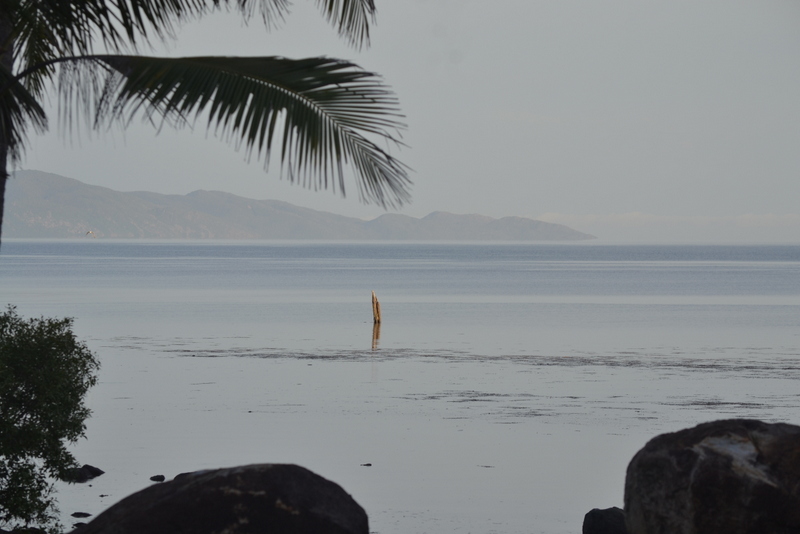
Jetty pylon at low tide

Jetty blown up

The jetty was demolished in 1976 (SC – to check exact date).

And for years after the demolition one pylon was visible at low-ish tides, but mid 2012 it disappeared, presumably rotted away. There were stories of great fishing there at night.
And another time, one dark night “I heard this really loud bang, then loud drunken swearing – X, who was drunk had managed to hit that pylon all the way out there by itself – God knows how”.

It was a great reference point “The jetty went right out to there”.

(SC – more to come)

Lockhart moved from “Old Site” to where it is now

The original Lockhart mission “Old Site” was moved to it’s current site in 1969.

Lucy H remembers moving from “Old Site”:

“It was 1969 that we moved over, as I remember my family and I were the last ones to move from Lockhart mission. My husband, Joseph, his grandmother Nellie Siev and grandfather Harry Siev, Rosemary Siev (adopted) and Novina my first child.”

She remembers that some people did not want to move.

“My husband was working at the store, so they had to send some of the people over. The old people were left there for the next trip to come. Some, just didn’t want to move. So we had to stay there ’til, you know, the food line because of the store to feed the old people – Lorraine, Grace, Ina”

[SC – more to come] (not sure of month of move)

Mary Lockhart

Lucy’s earliest memories of Portland Roads

Lucy still lives in Lockhart and her father was the captain of the lugger (Mary Lockhart) which used to deliver cargo to Portland Roads among other places. We asked her about her earliest memories of Portland Roads.

“It would be about 1956 or 1957 I would say. We were living at Portland roads, sorry, Old Lockhart mission. My father was captain of the Mary Lockhart – the boat – the cargo boat that comes here.
He was the skipper of the boat and we would catch a trip to Portland roads to get cargo and then they take it back (there used to be a big jetty and we used to run along the jetty every time)”

Mary Lockhart
Mary Lockhart