SC: Okay, basically what we’re hoping to do is talk about the times within most people’s memories, maybe the last 30 to 40 years and try to get stuff that’s not recorded anywhere else like the hippies and the fishermen and the parties and the sort of wild aspects of Portland Roads.
GP: With people’s names changed to protect the guilty.
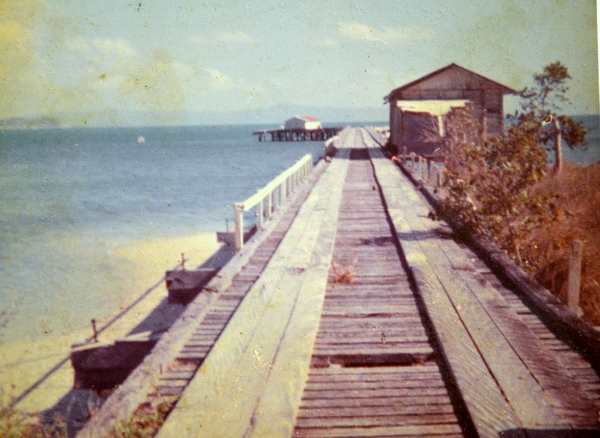
SC: Yeah, that’s right. And using the jetty as a focal point. I’ve talked to a few people. I’ve got the main characters like obviously Barbara Holdsworth, but anyone else we can think of who…..like I’ve heard there were two Stephanies. There was French Stephanie and Big Stephanie.
GP: She’s down here to visit us tomorrow.
SC: Which one?
GP: French Steph.
SC: Okay. Yeah, because she ran the restaurant there didn’t she?
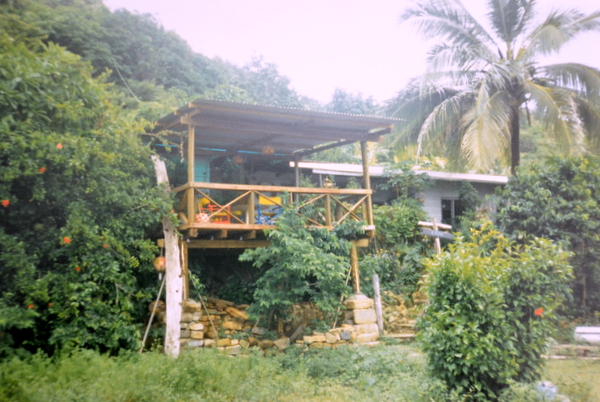
GP: Yeah, it was like a little café. Bligh’s Galley they called it. It was all completely unofficial, but they Steph and her partner Kim, they were very good cooks. So that’s why I’m going to visit them. Yeah, they had Christine’s….it was a café restaurant in Karumba and they bailed out from there and came down and I think the original shareholders up on Chili Beach….they came in and bought up a share in the old Rabstake or whatever they used to be called. Andrea, she ran it and bought a share and things didn’t work out there because of personalities and what have you. They were all living in each others pockets. But yeah, they got an arrangement with the bloke that owned the place. He owned the house that used to be there and they did a word of mouth deal so that they could get a little café set up.
SC: Is that next door to Marshall’s place now or is that on the actual wall?
GP: Right where it was. They pulled the old place down.
SC: So it was right where it was.
GP: Yeah, there was just a little bench there, that was the only area to build on. We had some photos somewhere.
GP: Yeah, of the old Bligh’s Galley. But yeah, people called Garski put it in there originally back in the 50s I think. They used to be the airport manager. They got a dozer down and they dozed the little bench out there in the side of the hill and built the house they had a caravan there at one stage. They built that bit of humpy on it, the original one. Yeah, they just opened a little café there, Bligh’s Galley. Kim built their deck out the front so they could spit on the cars as they went past. Back in those days no one cared.
SC: And do you know roughly how long she was there for, what year? Any idea?
GP: Helen, how long were Kim and Steph at Bligh’s Galley, can you remember?
HP: I don’t know.
SC: Yeah, I didn’t know she was still there.
GP: No, she’s down at Ayton.
SC: Is it still a restaurant or a café or just a….
GP: No, she just lives in there. She’s on the pension and retired. Her and Kim have long split up. He’s went back to New Zealand or something. Well they were there when you first came up. That would have been ’82.
HP: ’89.
GP: ’89, yeah.
HP I don’t know how long they’d been there. We can find out for you.
GP Well ring her up and ask.
SC: I wouldn’t mind talking to her as well. Do you mind asking her if she minds talking to me? I’ll have to do it by phone, I don’t want to go back now. But that would be good if she doesn’t mind.
GP: Yeah, she’ll give you the real deal on …, the guys up at Haggerstone. That would be in ’87 or ’88 or something like that.
SC: I’ve heard a rumour from somewhere that you could actually go there and say what sort of fish you wanted for dinner or lunch and they’d go out and catch it and come back, but I think that’s bullshit.
GP: Well…..
HP: They used to get it off the trawlers.
GP: I mean you couldn’t guarantee you were going to go out and catch a fish.
GP: Steph and Kim – well they went up to Wattle Hills and they bought a block up at Wattle Hills and opened their Eclectus Lodge. A little bird watching thing up there, Eclectus Lodge they called it but it’s a place that Rae and Ivan Vella actually bought. Well Ian’s got it now. He bought it off them or Roger bought it off them I think. One of them bought it. But yeah, that sort of relation. Kim and Steph their relationship – they went their separate ways. But then Hossy’s missus, Sheree, her and Julie ….Julie used to be a nurse at Lockhart. They sort of reopened it there and they were running little café….
SC: Julie was it?
GP: Yeah. They ran it for a year or so. Then officialdom started to come along and then the owner Alan Parkin, but he was an absentee owner, he was in Brisbane. He sold it, put it on the market. He had all sorts of plans on retiring up there. He came up for a while and he left. Lovey we used to call him. Yeah, he put it on the market. He had big plans about using it as a fishing holiday home, but once again it didn’t work out for him either. But he pulled the old place down and built the place that’s there now.
SC: Yeah, yeah he would have been quite sad that his sons weren’t interested in doing anything.
GP: That goes right across the board. Like Eric Price, the bloke that was in joint ownership with….well he actually owned where Westcott is now. So you bought it off me, I started that off. So I’m to blame in a way. Yeah, Eric had all sorts…..he was a fire chief in Gladstone and he had all sorts of plans on using the place as a sort of semi-retirement and what have you. His wife absolutely abhorred the place and stayed a couple of weeks and she refused to come back. So once again, yet another place on the market.
SC: Yeah, a lot of people buy themselves fairly quickly don’t they.
GP: Yeah, I don’t know. A lot of people don’t know what they’re getting themselves in there. It’s like that around here. Rossville and Bloomfield, people come through now until the end of the year and they go what a lovely place, we must buy here. They’ve come from a bitter winter down south, so they’re very amenable. And then they do a wet season up here and they can’t get out quick enough.
SC: I mean wet seasons are bloody hard.
GP: And particularly down there, because they get cut off fairly regularly. We’re not too bad here. Same up at Port I suppose. But they get cut off a week at a time. The roads are all impassable and…..
SC: I think it’s fantastic.
GP: It keeps the tourists down.
SC: So is there any sort of good story about French Steph’s cafe that….?
GP: Not that I’d admit to. I used to drink back in those days, it’s all hazy. No, I didn’t go there very often. I was away most of the time.
SC: I read somewhere….one of Alan Lucas’s….
GP: Yeah, he was quite a regular visitor old Alan.
SC: I’ve got copies of his various editions of his books and the bits that he’s changed. One of them really talks about people drinking out at the barge. I don’t know whether that was the Sarah Lee or another one. And then apparently I think the quote went something like ‘if you want to get drunk’ and then they’d be piled horizontally into a trailer on the back of a tractor and then driven back to the places they lived at.
GP: I never saw that happen. I’ve put people on the back of a truck a few times, but….
SC: Oh right.
SC: Was that Slack Dick.
GP: No, Slack was another one. That was Dick Carmedy. He died in Cairns, old Slack. No, old Dick Kirk….Kirk and Lizzy used to live out there and herb hill out on the way to Jimbo’s old place. He was from Cedar Bay old Dick.
SC: Was his name Kirk?
GP: Dick Kirk. Richard Leo Bradbury Kirk. He got his name from his mother.
SC: Dick Kirk, okay so he was her Neil.
GP: But yeah, a few times. Because he was a really bad epileptic old Dick.
SC: Was he the bloke who had the fit in front of your place. You told me about that.
GP: Everyone who had a house in Portland Road District had had Kirk chucking a wobbly and I mean he even used to have grand mals – they’d go for four hours. Yeah, that was old Dirty Dick. He was actually a likeable bloke, but he was dreadfully obnoxious when he got on the booze and he wouldn’t take his epileptic medicine. So he’d have these grand mal fits. But yeah, a few times Billy Mitchell used to have a tray back and load Kirky and lizzie and various other odds and sods onto the back because they would always deliver up there…..Jimbo’s, the ringers. Yeah, I don’t know if they had a tractor or a trailer. That could have happened earlier.
SC: I was talking to Dave. He immediately said that would have been Slack Dick. Unfortunate bloody nickname.
SC: He was quite well known here old Slack. He was a pretty good grader operator in his day. But the booze just got the better of him. Yeah, poor old Slack, he was one of the original……they used to call them the Chili Beach pensioners. They were all these bloody great able bodied hunks down there and they were all on various pensions of some sort. Slack was one of them, but there was Dick and Rhonda.
GP: Yeah, Slack and Rhonda.
SC: Dave was originally one of the Chili Beach pensioners.
GP: Yeah, the pensioners. They were some of the old original ferals that were up there in the ’70s or early ’60s. My folks didn’t go there til ’73, moved permanently and I was over in West Aust for 12 years of whatever and I didn’t get back until ’75 I think when I first went up to Portland Roads. The old original Idlewild mob, so that was the original hippies who were fine, we had no trouble with any of those mob, they were all…they didn’t bring attention to themselves because they all had humongous amounts of bloody ganja growing. Paul Clark, he got shot up at Black Mountain by Terry Sichter (sp??).
SC: Who was that again?
GP: He actually built the house where Hossy lives now.
SC: Who was that?
GP: Paul Clark and Vyda. They were found shotgunned to death up there at a house up at Black Mountain.
SC: And they built….
GP: They’ve built the house up at Jeff’s there. Originally – that’s Paul and Vyda’s place. Yeah, but they were all very good neighbours, they’d mind their own business and it wasn’t till the second wave that came up, the Slacks and the likes of them that just started getting some of these pretty nasty pieces of work. A lot of them were on the hop from the cops and that sort of thing. You couldn’t leave stuff out because it would get stolen and all this. They all used to pinch each other’s dole cheques.
SC: So who were they shotgunned by?
GP: A bloke called Terry Sector. He’s dead now, he shot himself in the head.
SC: Sector?
GP: Probably Schichter or something like that. Yeah, we used to call him Terry Sector. He was never arrested for it. He admitted….allegedly admitted to it, to ??? while he was locked up for something. But the police originally considered it an accidental death because the house they had up at Black Mountain burnt to the ground and when they shifted through the ashes they found the two bodies; Paul and Nita. Nobody missed Paul too much but everyone missed Nita because she was a really lovely lady. But she followed that bastard around and that was her undoing. It was drug deals going bad and that. Terry boasted about it. It wasn’t until they did the autopsy they found they’d got a choca block full of bloody SG’s. They had been shotgunned in their beds and then the house was torched. And he allegedly admitted to it. But he was never charged and then he came back years later and he was down at Chili. This was the second wave that came along and the story is he was drunk one night. He had a little 32 semi-automatic pistol and he was playing with it, but even his girlfriend said don’t wave that around, it might go off. He said ‘bullshit, it’s perfectly safe’ and it went bang and Terry was dead. That’s the story, so everyone sort of stuck by it because he was a pretty nasty piece of work. But yeah, the old original hippies; Paul and that mob and gradually, as I say civilization caught up with them and they didn’t like it so they peeled off. Then we had the second wave and that was a bit of a different story then. Though once again I’d taken over the mail contract from Dad by then. We personally never had any trouble living in those times because most of them didn’t want to draw attention to themselves. They all fought amongst themselves and waved guns and shots were fired and all the rest of that shit. We never had any trouble with him, he was always perfectly polite. You sort of take people as you meet them and like most of their own….it might be bad news, but we never had any problems with any of them.
SC: Wasn’t there a bloke that even up until the late 70’s would wander round with a pistol on his hip, round the jetty and…..
GP: There was a bloke down at Bloomfield used to do that. He used to allegedly go pig shooting with a 38. Not that I know of, no.
SC: What was that shell five…..yeah, the other one they called the Sarah Lee wasn’t it or was that something else. But that was the main one that used to be down there and have….
GP: It was left there all the time, the shell five, yeah.
SC: And then mother ships come up and….
GP: Yeah, it used to be mainly just full of fuel. It used to have container on top. Oh yeah, that’s some grog on board, he had huge grog sales. See old Kenny Underwood was the bloke that originally kicked off with Frank Market and Frank was interested in fuel. At one stage he was interested in buying where you are. He had……called himself Portsmith Fuel…
SC: Portsmith something wasn’t it?
GP: Anyway fuel sales was his big money earner, because he had three barges and he had the six…..shell six was down in Bathurst Bay. He had shell five at Portland Roads and then he had the shell 45, that was up at York Island. That’s the big one the 45, that was monstrous. The bloke that used to run that lives here, you might have seen him when you went to the markets. There’s an old see thru van. A van pulled up there.
SC: I think I have yeah.
GP: He used to run the 45 for years. Now up at York Island. But the fuel was Frank’s business and everything else was the barge operator’s. So Kenny Underwood used to run the barge because he used to get free freight so he’d get cost price from Cairns, cost price reduction for bulk. A pub in Cairns, a pub in Coen and a pub in TI complained violently to the licensing department that these mother ships were unlicensed sellers of grog. So they all had to run around in circles and get various licenses and the whole concept of it all went out the window as usually happens. In the early days it used to be a bloody freak. I’ve woken up in the beach a few times.
SC: Because people used to drink out on the barge and then come back in the tinnies didn’t they, but they also used to sometimes come into the beach, that was where as far as you got….you’d just lie on the beach.
GP: I came in one night back when Brett Devine still had the Tropic Trader running on there. He had a little store on board and you could buy frozen meat and basics. No fresh veggies or anything like that, but just basic stuff which is what you really wanted. We got bloody legless out there and I bought a couple of 100 dollars worth of frozen meat. We ended up drinking rum. I made it to the beach. God knows what the time was, pulled the tinnie up and collapsed in a heap. I woke up in the morning and all the local dogs had had an absolute feast. Chewed up plastic. But that only ever happened to me once. Damn the crocodiles. But then we never used to get crocs around in those days, they used to stay well away and if there was so much activity going on we were never worried about crocs on that front beach although you would now. Right up until we left there was some – we had a substantial one that was coming in quite regularly.
SC: I’ve got a photo of that one out on Rocky Island Beach that one of the boys took a photo of. They reckon that when they come to town, the boys on the hill, as soon as the croc hears their boat they reckon he comes in and hangs around – they clean a lot of fish. Yeah., they’ve got that one photo of him on that green spit that comes out.
GP: Yeah, I was diving out there and when I first came back I used to chase cray, whenever Helen and I came back to port she started at Lockhart. We were getting 25 bucks a kilo off the tails. I had no problems getting rid of them. So I’ve seen all those fringe reefs all over almost the way up to the Pascoe. We’d get good cray at times. Yeah, I was out doing that fringing reef around Rocky one day and I used to just….I always dive by myself. I’d anchor the tinnie and I’d swim down so far down the area. If there was anything there I’d just grab it and just swim back and I came back with a couple of crays and I just climbing up into the boat and looked across 150 metres and the lizard was parked on a spitter. I said ‘ooh I wonder if he knows I’m here’.
SC: I would doubt it. You know there’s a big brown rock just past the point. It’s got a concrete little….
GP: Yeah, it’s got the trig thing on it.
SC: Yeah, that’s Zoe’s rock now so I go down and play with her sometimes down there.
SC: Yeah and anyway the croc, the big one was out there and he went swimming along and then he turned round and watched us. Zoe was on the rock, it was low half tide. So I felt relatively safe and I just kept my eye on him. As long as I could see him I was alright. But he sat there and watched this for 20 minutes and then disappeared so then I thought about time to go home.
GP: The ones that you can’t see.
SC: Yeah, I remember you telling me that. It doesn’t actually help you much.
GP: No, I mean you can’t see a croc. No, they seem to be losing their fear. It’s that long ago since, you see Port back in the ’50s and ’60s, there was very intense croc shooting. Four or five blokes moved out of Port. Charlie Taylor, old Ronnie Hudson, the bloke that I found dead up in his camp at Stoney’s
SC: Oh yeah, hang on, who was that?
GP: Charlie Taylor.
SC: Charlie Taylor.
GP: Taylor’s Landing down on the Claudie there where the road goes, that’s named after him. I can’t think of the other….there’s various but they are the two main ones. They used to croc shoot the whole area.
SC: And who was the bloke, the bloke who you saw who died?
GP: Ronny Hudson. I found him dead up in his camp up Stony Point. But yeah, they did some maximum croc shooting round the area and before them there were quite a lot of blokes, transients….it was big money back in those days. So the crocs thinned out and the ones that were there kept a very low profile, but that was what ’75 or ’74 or whatever it was. It was made illegal. So over the years…when we first went there the wharf was still there. It wasn’t until the navy blew it, but there was one big croc….I think he might still be there because I’ve seen him when I’m up on the hill. He does a transit. He’s a pretty big lizard, maybe four emters plus. He obviously goes back to the days of the war. If you watch him….say he’s coming north, he’ll come through the channel between Rocky and he’d come up to within 100m, he’d be on the edge of the reef and he’d go. He’d disappear for 10 minutes or so and then pop up…..even the wharf on the pier is all long gone he just decides…..he must associate that area with guns or humans or bad experiences.
SC: Yeah, like when I watch. I can’t see him over there, so I just watch him go. Usually along the drop off. I was trying to track to see if I could record it every time he did so….that would work out how often….
GP: His movements.
SC: Yeah, which never seem to be regular. Yeah, you’d just watch him…..
GP: He’d be right up on the surface. He’s obviously pretty comfortable with….
SC: Yeah.
GP: And the tails right up.
SC: Yeah, you can see the whole lot of him. I watch him with the binoculars. No movement almost….
GP: Well the feet are doing the work
SC: Yeah, but moving along really quite fast. No movement with the tail.
GP: No, they only seem to use their tail when they’re in a big hurry. The rest of the time it’s just the paddles. You’ll see them….as you say they hardly move at all. And when they’re like that they’re comfortable right up on the surface. We nearly lost our previous Dane, Stanley Hill, the big hill to the north. It goes on a peninsular that goes out from the Pascoe. Well underneath Stanley there’s a little….I can tell you now it’s a really good place for barra.
SC: Stanley Hill Creek.
GP: It’s hard to see because there’s only a really small mouth but there’s a really big rock at the mouth and it goes in. There’s a whole lot of dead mangroves near those big white mangroves, it’s like a paling fence almost. It goes in….it’s only 400-500m long and then it branches out into two very distinct left and right. There’s a little waterfall at the end of either one so you’ve got fresh water. There’s fresh water comes out of Stanley Hill all the year round and that gets absolutely choca block full of barra. They come in at low tide and they’ll just lie there in the main stream facing up stream just waiting for various food that comes in with the water. Old Ronnie Hudson told me about it and said ‘Oh – good barra creek that one’. I pussy footed up there once and I counted 27 barra. I just got behind a tree and just watched them. I just sat there. I got myself comfortable. Some of them hardly move, just their tails, just enough to keep them head on in the current. The tide was going down. That’s when they feed on the dropping tide. There was a couple of them they were so close to the mud – they went down with the tide and bellied out on the mud and had a bit of a panicked jump to get back into the deep. But yeah, where you’ve got barra like that you’ve got lots of crocs too.
SC: Yeah, it goes all the way up the food chain doesn’t it. So that’s Stanley Hill Creek. That’s past…..
GP: Well you’ve got Pigeon Island, the mouth of the Pascoe over to the left as you’re going up the coast. It’s nearly the biggest hill and it’s about half way up it. It’s the biggest one there and it’s virtually straight in underneath it. It’s a real good spot.
SC: So someone else told me your brother Butch mined something on Rocky Island at one stage. Tungsten or…?
GP: No, that was way back at the turn of the century I think. He never mined.
SC: So that was way back, that wolfram mine was it?
GP: Yeah. When I say the turn of the century I mean the last century. No, I don’t know that they got too much out of it. I remember seeing a little report in the old Warden’s report. They talked about Captain so and so and party had a wolfram mine up towards the tip of Cape York which we presume is that one. I don’t think they got too much out of it.
SC: So it’s 1900s you’re talking about isn’t it. Yeah, early 1900s.
GP: I’ve been up there and gone through the dump heaps. They dropped a fairly good shaft. It would have been 15-20 feet I suppose. So they probably got a few indications on the surface, in the quartz. Nothing to get too excited about.
SC: Can you still see that? Is it still visible?
GP: Probably a lot of prickly bush has grown over it. Right on the very top.
SC: Right on the top of the island. I’ll go up there with Zoe.
GP: I’ve got a little bit of wolfram that came from there. I think it was the only bit that was there. A little bit of Rocky Island wolfram .
SC: Oh wow.
GP: She was a biggie.
SC: Yeah, but you know that pylon on the….
GP: Yeah, they were just pylons. They had them either side of the T-head to tie the big boats up to.
SC: Okay. That’s gone now.
GP: It fell over, did it?
SC: Yeah, only a short time ago.
GP: Wasn’t someone hooked onto it. Because that used to happen. The trawlers used to come in and tie up to it and were waiting for a tide.
SC: I don’t know.
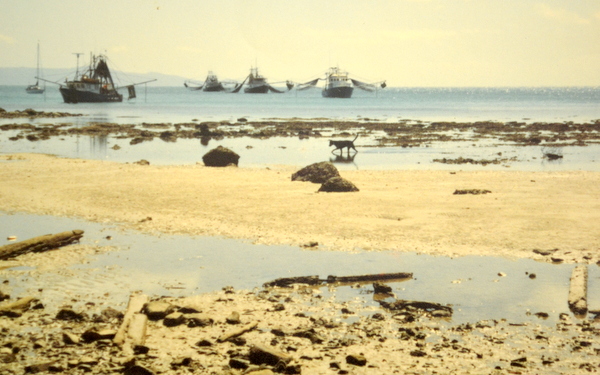
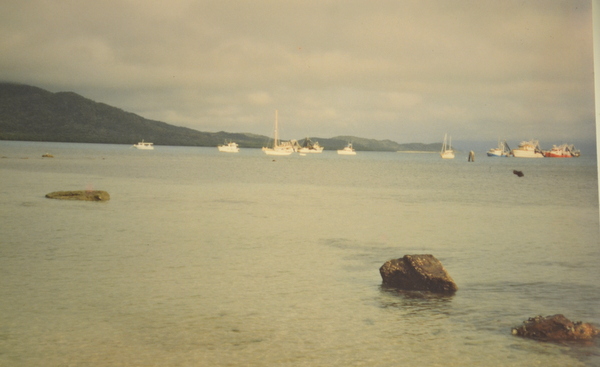
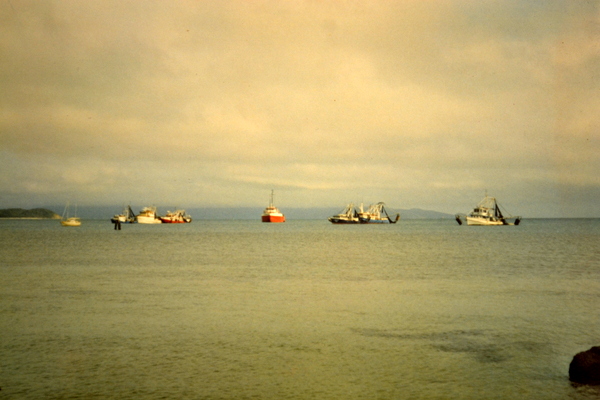
GP: 810 feet she was. The mines department had built a little short one in the 1930s. And then during the war – that’s when that was built, they extended the whole thing out to take Liberty ships. That would be just before the mother ships usually and there’d be anything up to 20 or 30 boats out the front. There’s more trawlers in Cooktown now, I think.
SC: Yeah.
GP: That was just after it was built. Notice they didn’t have the little house on the end there. I’m not sure what happened there.
GP: I don’t know if you’ve heard of Athol Chase. He said he’s really glad, because he did his PhD on….way back, 40, 50 years ago.
SC: Was he the bloke who was the priest as well? That’s still around. Thompson?
GP: Yeah.
SC: Yeah, that’s what I know. I’ve heard of Athol Chase.
GP: No, Athol was actually a professor of linguistics or some such thing, but he did his PhD on the Kuuku Yau the aboriginal time and all that. But he said that most people saw those people 40 years ago before they lost it.
GP: The other thing is that once the missionaries got in there, a lot of their oral history, they’ve mixed a bit of it up. It’s all the bora. I mean David Thompson brought out a book that called bora just like church, that’s what it’s called. I think that’s what it was called. In that he explores how they’ve adapted because of the oral history, they’ve taken the best out of all their different culture aspects, put them all together and there you’ve got this which is passed on orally to the kids.