SC: So just to go back. Croc shooting was till….?
BV: Well the crocs were protected in 1972, but we were given until mid 1973 to get all people who were in the bush back in and all this then stopped.
SC: Yeah.
BV: So they were protected in 1972, but we were still buying up until the year ’73 and then it was all banned.
SC: And there would have been some really big crocs round then?
BV: Well they were all salties that came from up here. There wasn’t any freshies for miles. No, I don’t think there were any freshies come from up here.
SC: Yeah, because they’re only up Darwin, aren’t they? Have we got….?
BV: No, there’s freshies in Lakefield National Park.
SC: Oh are they?
BV: Yes freshies are mainly in the west flowing -Gulf of Carpentaria catchment- rivers. They need big sand banks to nest in and the west flowing rivers like the Mitchell provide this best. They lay their egg in the sand like a turtle and the sun provides the warmth . The saltie on the other hand uses a vegetable matter mound rather like a megapode and the exothermic reaction of decomposition provides the incubation warmth.
SC: To heat them up.
SC: So what was the name of that bloke, the last croc shooter, what did you say?
BV: Jimmy Doctor.
JP: He died about 93, 94 sometime
BV: He was Albert Doctor’s father and Albert died only last year or something. A couple of years ago now. He was like the spokesman for the Kuuku Yau.
SC: Okay, so he was Albert Doctor, the older folk. Yeah.
BV: What was old lady doctor’s name?
JP: Miriam.
BV: Miriam. She died not a long while after her husband.
SC: Jimmy. So were you living up here when you were buying the skins?
BV: No, I was in Cairns. That was the centre, they’d (croc skins) all come to Cairns. In those days, Ansett had the mail run and they’d bring croc skins back as back-loading. Five cents per kilo. Made it possible. Another method of freight was with Mason shipping. Don Mason was skipper of the “Posidon” a coastal freighter which and this vessel carried most of the skins to come by sea. Initially Don would buy the skins off the Lockhart shooters (sometimes in an out to sea rendezvous) and I would buy them from him. Eventually he decided to simply carry the Lockhart skins as freight and tell me who to pay. We would pay the shipping freight.
SC: So that was back early ’70s.
BV: Yeah, I started in ’66 and then I wound up in ’73 when the protection came in.
SC: Okay.
BV: So you’ve done all the history of the area?
SC: Not really. I’ve had one short interview over with Dave at Resto. But he did have some good stories and I’m going to go over there and get his log of who’s stayed on the island and who’s been there.
BV: The visitor’s book.
JP: Visitor’s book, yeah.
JP: That’s an interesting document, that was given to me when I looked after Restoration Island from ’87 to ’95.
SC: You were ’87 to ’95 there.
JP: And when I stayed there, the Queen of the Isles used call in there.
SC: Oh yeah, every winter 40 to 50 passengers.
JP: Every week 40 to 50.
SC: Oh every week, sorry, yeah.
JP: And one of the passengers was a lady called Dulcie Garske who was the caretaker of Resto 1967. She brought back the Restoration Island visitor’s book of 1967, which is still on the island. She was a lovely lady. She actually was one of the first residents of Portland Roads.
SC: Okay.
JP: In ’67. She gave me a photo of Portland Roads in 1967. It just showed a caravan and the mango trees, which doesn’t fit in with those other photos that Greg was showing. So I’m not sure if there was cyclone or what happened there. There seems to be a disparity in the photographic evidence.
SC: Yeah right.
BV: Yeah, The Camp Oven was from the war, second world war construction, as a kid in Cairns in the 1950s there were some buildings of the same type of design and construction. Cyclone Agnes in 1956 blew most down.
JP: Where the restaurant is now.
BV: When it ceased, the second world war, his relations left vacant houses to live in this classic igloo shaped wooden home there. He called it the camp oven for obvious reasons.
JP: History of restoration in 1970.
SC: Yeah, I’m sort of going to just get hold of the stuff from everyone and then work out which way we’re going to go with it. I mean the themes that we were really interested in was jetty, fishermen, hippies. You know, like jetty fishermen hippies all congregating around the jetty and we were going to use that as the sort of focus. Only because there’s so much information we’ve got to limit it to some degree. I mean we’ll probably keep on going with it outside the grounds of the grant afterwards anyway. So…

BV: You know of course that the hippies were all refugees from Cedar Bay.
SC: Yeah. Yeah, I know that the first wave that came through were the ones from Cedar Bay, who mostly were quite harmless, but then there was a second wave and that’s when I think it was home made speed happening and lots of….
BV: It had lots of unsavoury types.
SC: On the run yeah.
JP: Interesting characters.
SC: Yes. And I did read in Alan Lucas’s yachting, one of his yachting books about, he witnessed people having a party on the Sara Lee, was it? The nickname of that boat, because you know, the barge that was there with all the alcohol?
BV: It was called Shell 5. (or “the barge ” or euphemistically “the dredge”)
SC: Shell 5, yeah. And then….yeah, someone said that was nicknamed the Sara Lee because he could buy Sara Lee cakes or there something.
BV: You could buy all the good stuff. You could buy diesel, petrol, wine, beer, spirits and chocolate. And cigarettes.
JP: And cigarettes.
SC: And cigarettes, yeah. Essential supplies. Yeah. Alan Lucas talks about people getting blind drunk on that or being on the jetty or something and then being stacked horizontally onto a trailer behind a tractor and then driven out and then rolled off the trailer at their house. And Resto Dave reckoned it was Slack Dick, whose unfortunate nickname…
BV: Richard Carmody.
SC: Yeah, who could quote Shakespeare or great buckets loads of Shakespeare?
BV: No, he was an educated guy. So….
JP: Richard (Slackdick) Carmody’s father was secretary to Prime Minister Curtin.
SC: Okay.
BV: He was skilled in engineering. His brother was with both of the money like a [unclear 00:13:52] and he was sent to public school in London. He was educated, he was well read.
SC: But someone said he had a girlfriend called Rhonda
BV: Rhonda….she was fun. I didn’t mind Rhonda. I mean she wasn’t an intellectual or anything she also had two lovely kids Crystal and Rory .
JP: I remember there was about 20 alternate types living down there over the years.
JP: They used to get up to shenanigans, including full moon markets.
SC: Was that up here or down there? Oh okay, because I’d heard about the ones up at Port.
BV: Sometimes they’d go on the beach.
JP: We had a few down at Chili beach there at Wongi Point.
SC: So were they called the moonlight…no, moon?
BV: No, it was a full moon.
SC: Full moon, okay.
BV: They put them on then because when the full moon was on the prawns weren’t catchable.
SC: Of course, yeah.
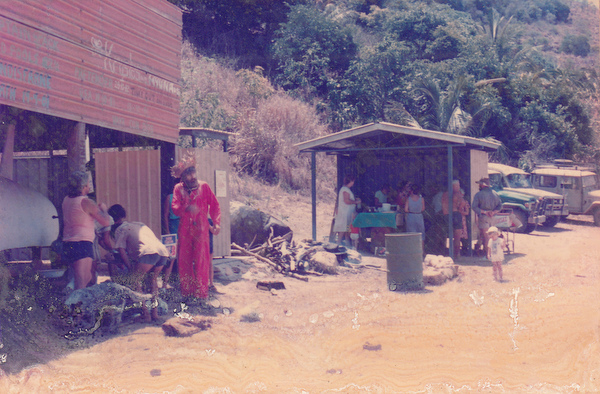
BV: Well the market, the term markets was used loosely because what it amounted to was someone getting a whole heap of beer cold and that was it. It was sort of working out who’s going to do the beer this market….’alright okay you do it and we’ll all buy it off you’.
SC: So there must have been some wild times there.
JP: Yeah it was.
BV: Yeah, but they were all pretty good though. They were real convivial markets you know.
SC: Yeah.
BV: Yeah, there were the New Year’s Eve parties down there, we had those until 2000
JP: At the most there was only about six or seven fairly well built bush houses, you know a pole construction. Often with a sleeping room upstairs and a few rooms and a shower. They had a well and water came through.
SC: And I heard there were really good gardens there for veggies as well as other things.
BV: Yeah, they did have a certain green thumb.
JP: You know, there were kids there too. Like babies. Rhonda have two kids. Stephanie had three girls.
SC: That was big Stephanie wasn’t it down there. There was French Stephanie had a restaurant and big Stephanie.
SC: Big Steph had some kids still?
BV: Three daughters.
SC: Three daughters. And is big Stephanie around still?
BV: She is. I got a Facebook message from her daughter Skye inviting me to her 40th birthday at Ravenshoe and she said that her and mother were living on 17 hectares near Ravenshoe. I don’t know where it is. She said her mother’s really, really well.
SC: And she was sort of the matriarch of that, wasn’t she?
JP: Yeah, basically. There were some characters…like Terry Sector who was with us in those days.
SC: Oh yeah, I did hear about that.
BV: He showed his girlfriend, this is how to use the pistol or this is how the safety works – bang. That’s the story that came out.
SC: Yeah and the cops didn’t do anything more about it or something.
BV: No, they were just glad he was gone.
SC: Because he was quite rough I think.
BV: Well he was fine here, but he had the reputation of being responsible for the Julatten murders. He was actually tried for the Julatten murders, but the police had gathered the evidence incorrectly and it was thrown out of court. Who knows?
JP: He always [unclear 00:19:46] at his place. There was a sergeant at the time, Robbo.
BV: It was my phone Billy Mitchell came to ring the cops on when Terry Sector died. There was no Phone on Chili beach then or now. I had flown to Cairns on the same plane that Terry Sector returned to Chili on . We nodded good day at the airport. He died that night.
SC: Flown out.
BV: As soon as I left the mates staying with me ,Curley Mathew and Collin Billingham, threw a party and my bottle of scotch disappeared at this party. The blame for this disappearance was hand-balled to Robbo the cop in Lockhart at the time who had responded to Billy Mitchell’s call about the death. The boys told me that Robbo had come to my place mistakenly (Sector’s remains were on Chili) and joined the party to celebrate the demise of Sector. They claimed in his exuberance he consumed my scotch – I never really did get to the bottom of this.
JP: That’s the sergeant.
SC: Which is quite possible.
JP: He was a real rogue, he eventually got the sack from the police force.
SC: Did he?
JP: He was a very unpleasant character.
BV: And he went round there and took forensic photographs, but he was that thick,and/or drunk, he didn’t realise there was no film in his camera. So there was no…
SC: Shit.
BV: No forensic evidence. And he rang up here the next day and said ‘don’t let anyone touch anything’. But Pedro had already gone down to clean the place up because there was blood all over the bloody wall and he didn’t want his kids…so he’d cleaned the whole place up quite thoroughly .
SC: Well probably can’t put this in the…
BV: Apparently they threw his body into the back of the police ute like a bag of spuds and drove off to Lockhart with it ( I was told this by Pedro )
SC: Yeah, of the wild and strange characters. I’ve got to get some more information on Barbara Holdsworthy.
BV: Holdsworth.
SC: Holdsworth. And I’ve got to talk to Billy Mitchell, I think he’s probably the best…
JP: Yeah.
SC: I’ve been told he’s the best. And Jim and Sandy are going to get hold of Billy for me. We’ll go up and talk to them about her.
BV: Yeah, well her husband was Dougy, Dougy. And he was…well when I came here they were living here then. And Dougy had a different arm, he’d had an accident with his arm and so he only had use of one arm.
SC: Okay.
BV: Dougy Holdsworth paid my brother in law and sister to drive down to Pt. Douglas and bring back a load of tools . They were the oldest tools you’ll see and included a hand operated nail maker. My brother in law Harry had an old PMG truck and had come to build my house.
SC: Really.
BV: Yeah, that will still be over there. No one will have bothered to steal that. And there was a heap of stuff, but that was the thing with Harry, he really sort of….
SC: Well would you have to have special….you’d have to have special wire?
BV: I suppose you would have to, I suppose so. I wouldn’t know.
SC: Wow, I didn’t know such a thing existed.
BV: Well neither did I.
SC: Bloody hell.
BV: That’s what Dougy told us. To make a nail. You can adjust it to make…
SC: Any size, any way.
BV: Different lengths and however you wanted them.
SC: And that belonged to Doug, Dougy.
BV: That was part of Doug’s gear. You know them PMG trucks, they had two seats in the front for workers and then there was like a four or five ton truck. Dan had a small trailer. I think it was PMG truck. Do you know the old PMG trucks?
SC: No.
BV: Yeah, so that was that. I don’t know what Dougy used to do before….or whatever happened to him. But he had all his equipment to suggest that he was some sort of…
SC: Builder or tradesman.
BV: Pioneer equipment, you know. Actually my brother in law would remember what the contents of the truck was. He didn’t tell me that, but a lot of other stuff. He was up with Wattle Hills.
SC: Was he? Who’s that?
BV: Harry Mara
SC: Yeah, that nail making in particular is a fascinating bloody thing.
BV: Yeah, well he’ll tell you more about it, I didn’t even see it. He just told me that.
SC: And what was his name, Peter?
BV: No, I can’t remember his name, but we all called him Harry.
SC: Okay, so…
BV: Well they came up with….we all came up with…. we got all this gear in ’87 and we had to land at 20 feet and bring poles and everything out here.
SC: That would have been fun in those days.
BV: It was only about half a ton an inch.
SC: Still.
BV: And I had a ute and I had a frame on the back and a frame on the front. And when I go to Lockhart I would just pick it up with the forklift and pop it on and drive back and park on the side like that and untie it and just let it roll off. Pull the rear vision mirror in. They got some of it delivered, they brought that tractor up which brought some of it out on site. Some of it…the rains came and they could only dump it out as there was no other road and they just had to carry it up there with a chain block. Winch everything up or come one at a time, winch it up in the air and drive underneath and let it down. Put the new tractor here.
JP: That’s when the road from Lockhart was terrible, just outrageous.
BV: Yeah, it was closed in the wet season.
JP: Impassable.
SC: And was that the part when you never used to….hardly ever do it by yourself, you’d always go in convoy or was that…?
BV: You could do it by yourself when I first got here. You just had to put her in four wheel drive and low range, second gear and just charge. Just let it fall into the ruts and don’t stop. And there was a second road at the far end of Chili Beach. If this one was closed you could get in that one. You had to wait for low tide to drive off the beach.
SC: Did that come right through here, the one from Chili?
BV: No, you’d get to the beach, if the tide was low, you could drive beneath the beach. If the tide was in you’d have to wait for low tide. So what were some of the – oh yeah there was Johnny Dopefreak.
SC: Johnny who?
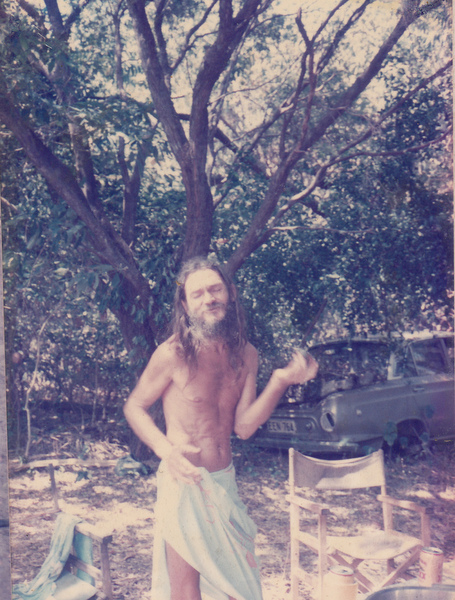
BV: Johnny Dopefreak. He was an Austrian guy.
SC: Dopefreak.
BV: Dopefreak. He changed his name by the deed poll. From Hans Gerharter to Johnny Dopefreak.
JP: And he was a member of the Marijuana Party in Darwin in 1975.
BV: He was running for prime minister, he was the Marijuana Party. And he was….he’s lost the plot a bit, Johnny, but he was actually a prosthesis manufacturer. That was his trade. Because after the second world war in Austria, there was a big call for
SC: Yeah, big market.
JP: Sort of an acid casualty you know, with a habit of free association. He had a dwelling down here, just on the beach, which he called a temple to womenhood. Temple to women, you can see he had a lot of Landrover seats on the ground and various mobiles scattered around and they were on shelves. And pictures of scantily clad women from the 1960’s. He eventually got emphysema and moved away.
BV: But I mean he was a harmless sort of a guy. He was good to go for a walk with and have a yarn, and if you’d got to Slack’s early in the morning he was an interesting guy to talk to. You know, before he got too pissed and that. He’d always have a yarn, you would never know if it was accurate or slightly off or embellished. But you’d be thinking about it and wondering.
JP: He was quite engaging. He could recite volumes of poetry ….. just splendid.
BV: Once during a drug raid the cops had Slack bailed up in his shack and as others searched two of them sat and chatted to Slack. When they thought they had him in an unguarded moment they slipped in the question “Slack old mate how do you get your dope to cairns” Slack immediately told them his MO ” I fax down the dope and they fax back the money”
SC: So there’d be stuff he’d make up or he’d pull out from Shakespeare or where ever?
BV: Yeah, quite a lot of stuff. And he famously, on his deathbed, he ended up with liver cancer – he was only in his fifties. My sister Mary was friendly with him. She used to go down and visit him in hospital when he was dying. But the end’s near and everyone’s packed around his bed, he props himself up on one elbow and he looks at them, he says. Well he said…and he was talking with his loud voice; ‘if I’d have known that I was going to live this long I’d have looked after myself a bit better’.
BV: But he told me, in his time he’d been a businessman. He had a business one time dredging sand for concrete. And he did a lot of work on Green Island in stabilising the erosion and stuff. Pumping sand…he had a big sand pump.
BV: Yeah, so what else do we….so do we drag up these old stories what the….
JP: Oh the yoghurt story.
SC: The yoghurt story.
BV: Yeah, yoghurt story.
BV: Well anyway, by hook or by crook, someone smuggles a yoghurt culture into Australia illegally from a remote part of Newfoundland in Canada. And the culture had been in existence for 150 years, so they’d been making yoghurt with this culture. It probably came over on a boat from bloomin’ France or somewhere. Whatever.
SC: Why is it illegal? It’s just the law?
BV: Well it’s milk product. It had to go through quarantine.
SC: Yeah, which would kill it presumably.
BV: Probably.
JP: Foot and mouth disease is one of the risks..
BV: Anyway it was smuggled in. And the person that’s smuggling it in, worked out the timetable for the air postage so that it was posted in Sydney for such a time and it would catch this flight to get to Cairns, catch that flight to get to Lockhart so that they could get in to meet the plane to minimise the time without refrigeration. It happened in the wet season and there was a bridge gone. So crocodile infested waters had to be forded to get to the airport. Motor bikes were involved and foot runners and dog paddlers were involved to get this back to the camp out here. And finally Rainforest got through, swimming the creek with it in its mouth. You can imagine. Anyway, it sort of gained….it gained holy grail status by the time it arrived. And when it arrived, they put it on the table and almost fell down and adored it and decided that to celebrate its coming a party was in order.
SC: As you would.
BV: So this gay debaucherous party went on for three or four days.
SC: I think I know what the end of this is going to be.
BV: And in this morning they woke up, all around the table there was yoghurt percolating away on the table and Ziggy the dog licking the bowl clean. So that’s what happened to the 150 year old yoghurt culture. It gave Ziggy a glossy coat.
SC: Yes, I can imagine. Well those sort of days are actually lost aren’t they? Because nothing….those community parties, sort of drunkenness and….
BV: It was all that. Now everyone is stuck behind their computers and is playing computer games.
SC: But even out here it still wouldn’t happen today. Like there was an era of that sort of thing happening that I don’t think would happen…
JP: Yeah, no the community has been fragmented a bit for the last eight, ten years. Used to be we had markets; fruit and veg, parties and stuff.
BV: And because of that fragmentation, when the lease came up for renewal they just let it lapse because no one wanted to fund the new lease.
SC: Of Idlewild?
BV: And it always used to rain. And it rained and no one wanted to
SC: Yeah, it seems to have a lot of those communal things, doesn’t it? But after a while it’s just too hard and we get too many people.
BV: And of course in those days the whole area was still the Claudie River mining field.
SC: So the Claudie River mining field….?
BV: Yeah and as such the legislation was still current, you could take a homestead lease and that’s how these four blocks came into being. And Chips was caretaker on Restoration Island. And Newmont was still mining. They’d come every year because to maintain a quarrying prospect, that’d be 20 grand. So there was mining activity…a geologist name of Kinnane, told Chips, told Chips he could over peg on the hippy’s lease a homestead lease. So he did this one for his brother and that one for himself and one on the point for Butch Pope and where Neil Dahl is was for Kinnane himself.
SC: Was that legal or semi legal?
BV: No, it was legal. It was all legal. Once a goldrush has been declared there’s special legislation that applies to mining fields. So there’s a short circuit all this redtape. So immediately do this and immediately do that. You don’t have to wait for legislation to change, get council approval and stuff like that. So it was all legal, nothing semi legal about that. So Chips got off the island and pegged the lease there and cleared it and built himself a joint. His brother came here took one look and wouldn’t want it and sold it practically untouched to my cousin who was a builder in Cooktown and then at Weipa. He formed a partnership with one of the Cook Shire councillors who was…in those days councillors were appointed as the government dissolved the council. It was run by administrators and he was one of the administrators doing the work of an elected councillor. And the other partner was….
SC: Were these called the something seven?
BV: They were the magnificent seven.
SC: Magnificent seven.
BV: Yeah, there were seven administrators. It was like a board. And the other partner was Rick Richardson who was the health surveyor. So the three of them got together and there was a need to demonstrate that you were going to live at the place. You can’t have a homestead lease and you’re not going to live on it. It’s not for speculation, which is what they were bought for. So they had to spend 20 grand in the first 12 months, so they got in, put the bottom shed in and there was a flushing toilet down there and they put in a water tank and dug a rubbish pit and they put a road in. So that road goes past Chip’s because you had to put access. And once they did that…well my cousin wanted to move south so I bought him out and then the other two said they weren’t happy about buying that house, so I bought them out.
SC: So three people owned this and you bought the three of them out of it.
BV: That was back in the late ’80s. And then about mid ’90s the government encourages us to feeehold so that’s what you do. In fact they wrote to us and said put in your application for freehold now and when we get round to freeholding them there will be an adjustment if you’ve over paid. So we’re now freeholders. We got a cheque back.
SC: Pretty good deal.
BV: Well it was an administrative nightmare for them to have all these different lease titles and they just wanted to get rid of them. And they did gazette the mining field then so that no one else could take the land. Because there was an objection to these leases being established. You’d have to go to the mining warden in Cooktown and everyone was expecting the mining warden to uphold the objection, but for some strange reason he didn’t. He allowed it to go through.
SC: So what were they looking for? Was it gold here?
BV: Yeah, it was gold. If you have a homestead lease you don’t have to do mining. It’s just the…I mean you might have any business in a mining field, you could be a whatever other than a miner. You could be a miner as well and still be in a homestead. So there was no need….there’s no necessity to be involved in mining in any way if you have a homestead lease in a mining field. And a homestead lease could be over pegged on anyone’s lease for any reason. Well you could apply and if the original lessee had a good reason why you couldn’t over peg his lease, the mining warden would review it and make a decision. But I mean, the mining company would come and find an ore body and just peg out a huge lease and really only want a little bit of it.
SC: Yeah.
BV: And if you….the more that was excised out of that, the less rates they had to pay. As long as it didn’t interfere with the primary lease…
SC: Yeah, they didn’t care.
BV: They didn’t care. Yeah and of course in those early days, Newmont used to come in every year and spend 20 grand. Everyone got a job and they opened up all the roads. They put in costings and taking samples and were doing assay tests and all that sort of stuff on them. So everyone sort of looked forward every year to a few months work while Newmont was here, complying with their authority to prospect, keeping it open there. They eventually let it lapse. Can you remember when that was?
JP: No.
BV: Hoswell would know. Yeah, Hoswell would know.
JP: Shane too.
BV: They’d know when the last time they worked there.
SC: And is it EUMOND or NEWMO…Newmont, was it?
BV: Newmont [spells it out]. I’ve never seen it on the stock exchange.
BV: And of course when we first came here, the skeletal remains of the old South Pacific miners were still there. They had boilers and stampers all rusted and the ship’s motor, the generator, conveyor belts and…
SC: And where was that?
BV: Down Scrubby Creek mine. We went in there and it was like they’d just left yesterday and were coming back tomorrow. If you looked at it closely you could see it sort of rusting away quietly. Now eventually they sent a team in and collected anything that could be salvaged and they took it away and dug a huge pit and pushed everything into there.
SC: Oh shit.
BV: But that started up when there was some suggestion that there was skulduggery in the establishment. It just got started and it never…
SC: Never went anywhere.
BV: No, Dave and Mike used to drive a track there. They never got enough gold to keep going. The whole area’s still on National Park but it’s still mining fields. If you have a look at a map of the National Park you’ll see a big square in a different colour to the rest of it, that’s the old Scrubby Creek mines. It’s still considered as a mining area.
SC: Well mining can trump anything, can’t it?
BV: I think it can, especially now.
JP: Again, now. The roads are all covered in trees, it’s been years. You can’t drive there now. You should see remnants on Google Earth, you know where the turnoff is.
SC: Where?
JP: You know when you go to town where the first bitumen starts there. Top of that hill, drive down through the forest. Well just on top of that hill, there’s a turnoff to the right.
SC: Oh yeah, where the Land Rover is?
BV: Yeah, the old Land Rover.
SC: Is that the road that used to go up to the Pascoe River?
BV: Yeah.
SC: Because you can’t get up that anymore, can you? It’s all…
BV: No, that was a beautiful drive that.
JP: It was called Youngman’s Crossing.
SC: That’s it. Pascoe was it? Or Young Man’s Crossing?
BV: No, a couple of k up, where it hits – a couple of k up from the mouth. It was a kilometre maybe from the mouth. Beautiful little camping area there.
SC: Yeah, I’ve heard of that.
BV: It was gorgeous. I actually went for a holiday there before I came here. We went for two weeks there just camping, fishing. That was beautiful. At low tide, you can drink the water, it’s fresh. High tide and low tide. Really pretty. Really pretty drive just as you almost reach the Pascoe we’d go up on top of this ridge. It was really razor back ridge and you could sort of see out to the sea and all these trees going along and you could see through breaks in the trees – wonderful views. You could drive along the top of this bloody ridge and you could descend down and you’re on the Pascoe. I was looking at it the other day with Clarkson, they’ve got a grassy area up there, they’ve got a fence and they manage it. Right alongside the road, alongside the ridge thing. You can see that on Google Earth.
JP: And naturally occurring grasslands.
BV: Who was that bloke on the barge? Remember there was Dave I think who was there first and then Dave and his wife and then…
JP: Keith and Marge.
BV: Keith and Marge. He was the bloke that whenever they had a party on Chili Beach, they would run out of grog, and then someone would volunteer, the hat would go round and he would jump in, he would go over to the barge and he had his cap and would bring it back and then it all started again. He’s there and every couple of days the boat came back and he’s got to load all this grog and he’s going back to the party. In the end he said actually ‘I’ve been working 40 years and I can’t spend money on grog like this. You’se are barred. I’m not selling you any more grog’ He just couldn’t stand it.
JP: At the end of the season though every barge manager usually went nuts.
SC: Yeah, everyone just went mad.
BV: Oh the bargy…the barge operators…the barge managers usually were a bit tetchy.
SC: Been there too long.
BV: Yeah, because the barge was only like one hundred foot long. They rarely got off.
BV: They were dumb barges, they were just…just floating fuel tanks. There’s this huge bloody fuel tank which is diesel and your 44’s of petrol you could buy. You’d just survive off them. They’d bring in a stock and you’d go out and buy petrol. And you’d just kick it into the water like a big depth charge, lasso it and snig it to shore. It wallowed in the water like a pig.
JP: One of the barge managers before I came here…I don’t know this fella, but he used to undo the top of the 44 petrol drum, siphon off 10 litres and do it up again and no one twigged …. fuel expansion gap you know. Years later the local boys found out and ooh
SC: Lucky he wasn’t around then.
JP: No one measured them.
BV: Yeah, but they were heady days then weren’t they?
SC: There were some stories about people going out to the barge and coming back to the beach and that was as far as they got. They were just drinking until they ran out.
BV: They would walk up to the road with the top ripped out of the carton.
SC: Gregor reckons he came back from the barge one time and got on the beach and woke up two or three days later still on the beach just with a disgusting hangover and not much memory of what had happened.
BV: And there wasn’t much refrigeration. In fact, one of the boys, one of the expressions he had coined was “Would you join me in a roomy?”
JP: And there were to-ings and fro-ings from the barge to trawlers in dinghies all day, and on one occasion one of the trawler skippers had this sawn off shot gun to use for dispatching stingrays and sharks in the nets and stuff. It was being passed from the trawler to the dingy when it discharged and blew off part of the knee of one of the ferals, who happened to be a junky. Anyway, the hospital was called, an ambulance came out from Lockhart clinic and they were trying to stop the pain and she was still screaming. They didn’t know she was a junky so they gave her the normal dose of painkillers, which had no effect.
BV: And old Slack of course, he got into home brewing. And he got a bit of tardy in the bottling of it, so in the end he worked out that you could dip your tankard straight into the fermenter, you can save on all that bottling.
BV: They used to brew beer out of well water,. so they were all sorts of problems..
JP: Especially when a snake died and he was in the bloody well.
BV: His mate was alcoholic too, and eventually the beer got so undrinkable that he said” Slack, this beer’s shit, I can’t drink this beer”. Slack says: I finally brewed beer you can’t drink, ya bastard. ” Nah Slack, fair dinkum this beer is shit”. Yeah, fuck ya then. So Mitch goes out and checks the well water … and there’s a big dead bloated python floating in it.
SC: Was that Billy Mitchell or was that…?
JP: No, that was Slack Dick and Mitch.
SC: Oh Mitch.
JP: Mitch, his mate yeah.
SC: Oh okay.
JP: Mitch was his mate, they were good mates. He knew that if he left any beer, Slack was going to drink it when Mitch went away….so in order to ensure that there was something to drink when he got home he would stash some beer in the fridge, but in the crisper, under something. He knew that Slack would never look in the crisper under any circumstances for anything.
BV: You know, he’d knew he’d won then. Mitch was an old union organiser.
JP: What was tattoo-ed on his knuckles?
BV: Something like ‘look out’ or…
JP: Yeah, that’s right; ‘LOOK and OUT’.
BV: Look out. And he used to have first aid caches around the place. So, you know, when there was a fresh supply of grog, he’d get some bottles and squirrel them away out in the scrub, so that if he was walking over here or walking back, he’d feel a bit feeble then he knew where he had to go….that was the first aid stocks.
JP: One of his rougher girlfriends he had, one time he reckoned she had so many tattoos, when you looked at her and she had no clothes on it was like reading the Mein Kampf.
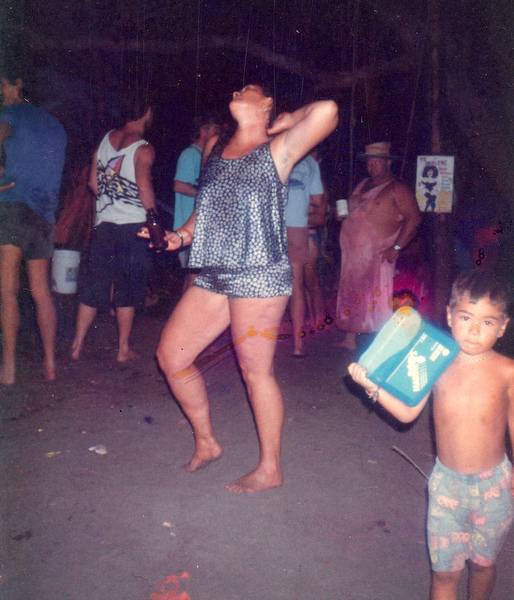
BV: What about those lingerie parties? One of me taxi driver mates from Cairns, his son grew up and went to a police academy. He’d been up here a couple of times on holiday and these two lads from the police academy came up and stayed here and they went fishing. And Stephanie just lived over the hill and she’d organised this lingerie party. Anyway, we went out fishing, we came back and I said to the boys ‘well I’m going over to this party if you want to come over.’ Old Jimmy was the Dad. We got ready and just followed the track and were sort of….so we go over to the bloody hill and come down. Old Jimmy is an old Irishman. He looks down at the goings on as we approach, it was still day light and he said to me ‘looks as if you’re pissed or they might want to fight you’. There were blokes running around with a fish net stockings, negligée and whatever. Three cartons of lamb had come up on the barge and come across this…what do you call it…lingerie party. And it had made it up to the camp and they’d stacked it and that’s where it started to pour out and started to bleed. And old Steph was sitting on it, barking orders about ‘more ice in the punch’. Anyway, Jimmy and I got a beer and we sort of melted into the crowd. Now 20 minutes later these two cadet policemen turned up. They had followed down the track and forged through the undergrowth and came out and I could see them and they looked….and they looked at each other. They couldn’t believe it, there’s not enough hand cuffs in the world. Ended up having a good time. Extraordinary occasions.
JP: What about the dope cake.
BV: A dope cake for a party.
BV: Their kids ended up eating it.
JP: The people got so wrecked they couldn’t move. They were actually paralysed in the party.
BV: Yeah, one bloke was so paralysed. He was sitting down under the tree covered in green ants and he couldn’t…he was trying to squash them and he couldn’t do it.
JP: He’d just overdosed on the cake …. without knowing. They pissed themselves, just couldn’t up to go outside to have a piss. Nice cake, chocolate on it. Oh and there was the space base time, that was pretty good.
BV: Oh yeah, there was the space base time …. 1989.
JP: Everyone was getting ready for the space base. There was a proposal to build a space base.
SC: I vaguely remember that.
JP: Yeah, that was at Temple Bay, wasn’t it? And who was that ABC reporter? Anyway, he exposed them.
JP: And there was a media report about the response of the local community. There was some comment about the alternative community would be unavailable for comment. And Stephanie chimed back and said, really quickly, “what do you mean unavailable for comment ? We were at home drunk, where we always were”.
BV: And what about Jamie Navarre? A freelance journalist published in the Sunday Mail and other stuff. She came up and wrote a story about the hippies on Chili Beach. And then Slack gets hold of the newspaper and he’s reading it out, and she’s being a little bit scathing of the lifestyle and living from hand to mouth. He’s reading this out; ‘and hippies on Chili Beach are living from hand to mouth’ and as he pauses to draw breath, Stephanie pokes her head out of the galley and says ‘Hey boys, the crayfish mornay is ready’.
SC: Who was that reporter again?
BV: Margaret McKay Payne
JP: Then she changed her name.
BV: She changed it to Eugenie Navarre.
SC: Say it again? Na…
BV: Navarre [spells it out].
BV: Yeah, she interviewed old Popey (Geoff’s Dad) down on the beach. And he was scathing. He waves his hand pointing at all the litter on the beach and ascribes that to the hippies. And it’s all bloody trawler trash, you know.
JP: What about the astronauts. Did you hear that story about NASA?
BV: Oh there was a whole suit, astronaut, a space suit
JP: A space suit washed up on Chili Beach.
BV: I remember it happening, but I don’t know what happened.
JP: They were sending it back to NASA.
JP: What about Butch Pope, do you know where he is?
SC: No.
JP: He was really crook about to die of lung cancer.
BV: Because reportedly he lived in a mine on Rocky Island. That was before the war.
JP: That’s ancient stuff.
SC: Apparently it’s at the top of…I want to go and have a look….you can still the remains of it, it’s just a big shaft. Well according to Geoff…
BV: I’ve never been to that site.
SC: No, neither have I.
BV: There was a shaft.
SC: Yeah, apparently a shaft right at the top of the hill. You can go up the top and have a look still.
BV: Naming of Chili Beach….it’s really obscure.
SC: Yeah, Cate went all through the internet just trawling stuff, trying to find it and couldn’t find anything.
BV: Me Dad and some of his mates stayed here through the war and they said it was never known as Chili Beach.
SC: Back then.
BV: But old Charlie Billingham told me that they pushed the roads through, because they used to play football down there at low tide. They used to use it as a recreational area. So they pushed one of the first roads through down there. But there was an old fence there and the barbed wire all the way through to Portland Roads from Chili Beach, it went through there’s huge coils of it never used. It was never used, it just sat there rusting away.
SC: Was that from the war or from farming before the war?
BV: It would have been when it was a cattle station. We used to walk through to Portland Roads. We’d go down behind Kinnanne’s and up round the back of Packers and across Packers where it’s dry. You’d come through to this…on the other side of Packers, you’d come through to this big tidal…extreme high tidal inundation area and the fence sort of runs alongside of that. The posts are still there. This was back in the ’80s…’90s, early ’90s. And there were coils of barbed wire as if they’d delivered it there to put it up and then…
SC: And never done it.
BV: And never put the fence up. You could probably get to it from that hospital track there.
JP: What about the time the hippies stole the bloody Suzuki rent a car
SC: What was it? Drury Dave…?
BV: Dreary Dave. They drove it up and painted it pink. They were going to take the cabin off and put the old Land Rover cabin on the chassis but it never happened.
BV: At one stage Dreary Dave was talking that he’s going to shift all these dope plants. So he stacked them up on the mud guards and put them up on the back and had them on the roof and everything. He was driving off and he goes through the tourist’s camp there and the tourists thought it was a float in a parade.
SC: Dreary Dave, dope plants that float, the tourists thinking it was a float in a parade. Was that in the stolen Suzuki or that was in another vehicle?
BV: That was the stolen Suzuki.
JP: It could have been.
BV: I think it was. It’s still down there.
SC: Is it?
BV: Yeah, it is still down there. All that’s left is the chassis and the decks and the engine block.
SC: Oh really.
BV: It’s corroded.
SC: Well it might be worth just taking a photo of that. The remains of the famous…so do you know where it is or I could grab you one day and we’ll go down and take some photos?
BV: Probably find it on Google Earth. You can see the spot where they left it…where it finally died.
JP: Well there’s always the Zac and Cat stories.
BV: The Zac and Cat stories.
SC: She was the….So it was Zac and Cat’s Eye, was it?
BV: Well Zac came here as a fisherman, he was a young fisherman and he sort of came ashore and stayed ashore and eventually sort of washed up here.
SC: So that would have been the second wave of the hippies that came in.
BV: Yeah, it was. That was like the…I mean they had a core that came in the first placements. George Perot, Andrea. Andrea was…her father was the editor of the Melbourne Age. I’ve forgotten his surname.
BV: Kirky was part of it, was he?
SC: I’ve never…
JP: Out on the road to the camp there, a little humpy sort of thing.
BV: He was a bit of an artist. He was an accomplished artist, but he could always has a morbid streak if you looked at any of his work.
JP All his faces. People know him for painting fridges, there was many a fridge he painted.
BV: Yeah, he painted fridge doors.
JP: Billy Mitchell?
BV: He was at Cedar Bay. And Rani
JP: Fan dancer.
SC: Fan dancer?
BV: Yeah, she was a fan dancer.
SC: What’s a fan dancer?
BV: Well it’s someone who dances behind a fan.
SC: Alright, was that in Australia or overseas?
BV: Australia as far as I know.
JP: Australia as the legend has it.
BV: I never actually saw a real fan dance.
JP: Yeah, we’ve passed the fan dancing days. She must have told someone she was a fan dancer.
BV: And Dusty, the Czech, he was part of it. He was the one who bought that water tower down beside the …
JP: He did?
BV: He built that, yes. It was built with a big bore down. It used to pump up to it and then it articulated water through the sands.
SC: So that’s up above Chili somewhere now, is it? Or was.
JP: Yeah, behind where the camp sites are now.
BV: Yeah, walking track.
BV: Well that was actually a road, that was a road that went through the Buckies. Johnny Buckpit and Pedro and Johnny King. That was alongside that road next door. At one time you could walk down to the swamp there. Yeah, these were all sort of free love and brown rice people that came up – they were pretty genuine sort of people – a little bit of dope, but they weren’t…they weren’t criminals in any way.
SC: So you mentioned some other people just then. I’ve got Dusty the Czech and then you said on the track…the walking track where the tower is….
BV: He built the water tower that provided articulated water to the camps there.
SC: You said there were some other people camped on that walking track, there was…
BV: Well Johnny Buckpit. He took in Pedro. Maybe Bucky found it after these initial…what they did is they took out the lease here.
SC: Yeah, that was the original Idlewild lease or is that another one?
BV: No, the original. Idle Wild it’s called.
JP: Rabstake wasn’t it?
BV: Rabstake Pty Ltd
SC: Rabstake?
BV: So what they wanted to do was live with their free loving brown rice and not ever be evicted like they were…
SC: At Cedar Bay.
BV: …at Cedar Bay. So they took over the legitimate lease and then they invited fellow hippy members to come and join them. Now pay $5000 and peg out five acres and grow their Chinese cabbage and whatever. But the only trouble with that is they didn’t have entitlement to multiple occupancy. In fact, on the three leases there was only allowed to be one dwelling. That was a problem with Wattle Hills until quite recently. It was only in the last 12 months that Wattle Hills had the title claims to allow multiple occupancy.